近日,我校数学学院“纳米物理和细胞物理中的数学问题”课题组在碳纳米材料破坏的微观机制与热弹耦合微纳结构振动研究方面取得了系列重要进展。相关成果先后发表于《International Journal of Solids and Structures》《Results in Engineering》《European Journal of Mechanics -A/Solids》《International Journal of Thermal Sciences》等固体力学、工程技术及热学领域国际权威期刊,充分展现了数学基础理论在交叉学科研究中的关键作用。
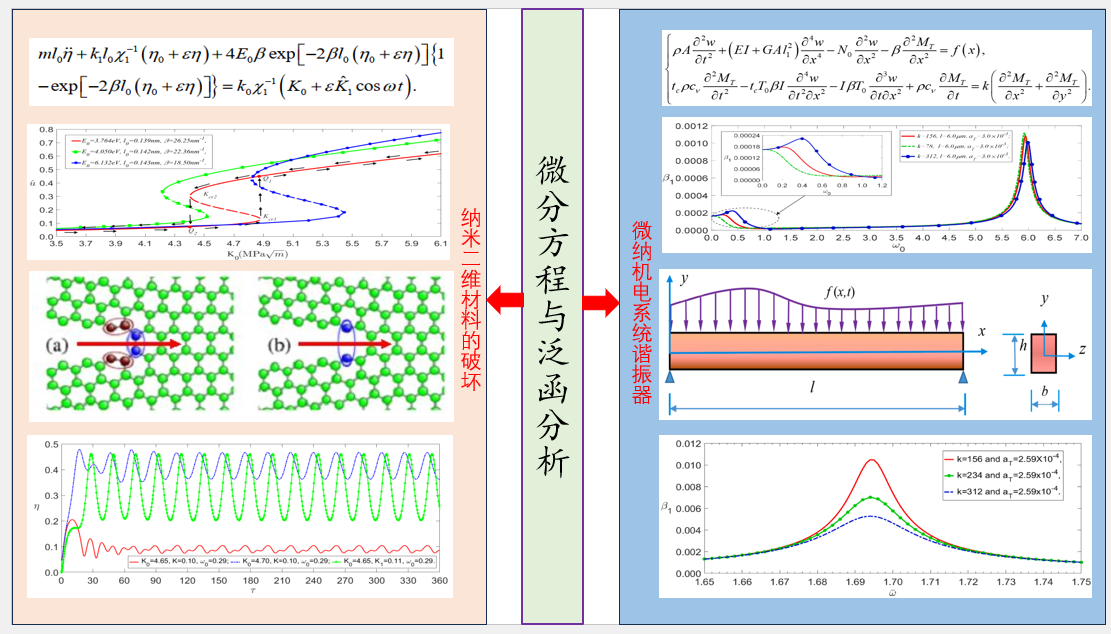
其中,数学学院黄坤教授与清华大学航天航空学院殷雅俊教授合作完成的研究论文《Bond rupture and atom vibrations at a crack tip of opening mode of graphene incorporating static stress intensity factor》发表于固体力学领域国际权威刊物《International Journal of Solids and Structures》。该研究报道了原子键破裂导致纳观裂纹形成的动力学机制,首次从理论上证明静态应力强度因子通过软化碳原子键的刚度,使低频外载荷通过共振将能量传输至原子键,进而导致石墨烯中碳原子键发生动态脆性破裂。这一发现为理解微观原子键破裂导致碳材料破坏提供了新视角,也彰显了非线性微分方程基础理论对理解真实物理现象的重要价值。
此前,黄坤教授与周兴伟教授通过偏微分方程理论和变分法,在工程技术领域国际权威期刊《Results in Engineering》发表了关于微梁热弹耦合受迫振动的研究成果《Linear free and forced vibrations of thermoelastic microbeams incorporating non-Fourier heat conduction》。该研究首次揭示了非傅里叶热传导在受迫微结构振动中的振幅“双峰值”现象。该成果与黄坤教授基于傅里叶热传导理论得到的热弹微梁理论相互补充,为已经广泛应用的微纳谐振器的精密设计提供理论支撑。相关前期研究以“Analysis of linear free and forced vibrations of microbeams with thermoelastic damping”为题,发表于固体物理领域国际权威刊物《European Journal of Mechanics - A/Solids》。
此外,黄坤教授还与南京工业大学吴继业博士合作,发现环境温度导致的弹性模量变化会显著软化碳纳米管的刚度,研究成果以“Nonlinear static behaviors of nonlocal nanobeams incorporating longitudinal linear temperature gradient”为题,发表于热学权威刊物《International Journal of Thermal Sciences》。
上述研究均来源于工程和物理中的实践问题,深化了人们对材料破坏物理本质以及热场与弹性场耦合问题的理解,并可服务于工程实践。相关成果是黄坤教授新组建的“纳米物理和细胞物理中的数学问题”研究团队群策群力、合力攻关取得的成果,也是与清华大学、昆明理工大学、南京工业大学长期合作的成果。未来,研究团队将结合数学学院学科发展规划,争取在数学、纳米物理和细胞生物学交叉领域取得更多特色鲜明的高水平研究成果。“纳米物理和细胞物理中的数学问题”团队建设和研究得到了学校的大力支持,并获国家自然科学基金项目和昆明学院人才引进项目资助。
延伸阅读:
[1] Kun Huang, Yajun Yin, Bond rupture and atom vibrations at a crack tip of opening mode of graphene incorporating static stress intensity factor, International Journal of Solids and Structures,
2026,114379. (IF 4.6) (//doi.org/10.1016/j.ijsolstr.2026.114379)
[2] Huang K, Zhou X. Linear Free and Forced Vibrations of Thermoelastic Microbeams Incorporating Non-Fourier Heat Conduction[J]. Results in Engineering, 2026: 110540. (IF 9.4) (//doi.org/10.1016/j.rineng.2026.110540)
[3] Huang K, Zhou X. Analysis of linear free and forced vibrations of microbeams with thermoelastic damping[J]. European Journal of Mechanics-A/Solids, 2025, 112: 105672. (IF 4.7) (//doi.org/10.1016/j.euromechsol.2025.105672)
[4] Xiong H, Huang K, Guo H. Nonstationary Oscillations of Carbon Nanotubes Incorporating Thermal Stress[J]. Journal of Vibration Engineering & Technologies, 2026, 14(2): 92. (通讯作者) (//doi.org/10.1007/s42417-025-02319-1)
[5] Wu J, Song L, Huang K. Nonlinear static behaviors of nonlocal nanobeams incorporating longitudinal linear temperature gradient[J]. International Journal of Thermal Sciences, 2025, 208: 109421.(IF 4.9)(通讯作者)(//doi.org/10.1016/j.ijthermalsci.2024.109421)


